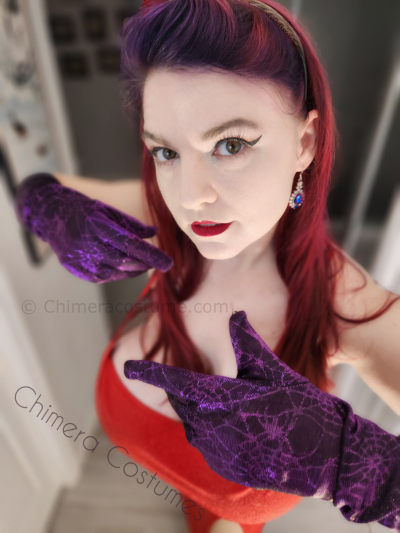
The Challenge of Jessica Rabbit
Jessica Rabbit's iconic red dress from Who Framed Roger Rabbit is one of the most technically demanding cosplay builds in the portfolio. The extreme off-shoulder neckline that stays in place without straps, the fitted bodice that must provide real structural support while appearing minimal, the exaggerated hip-to-waist ratio, and the deep-slit skirt that moves correctly while maintaining modesty — every element presents a specific engineering problem that can't be solved with off-the-shelf techniques.
Heidi's approach began with a full pattern draft from measurements rather than adapting any existing pattern. The proportions of Jessica's dress are so specific that adaptation always produces something that reads as "inspired by" rather than accurate — and accuracy was the brief.
Pattern Development
The bodice pattern was drafted through a series of toiles in a cheaper stretch velvet to test the structural approach before cutting into the fashion fabric. The key challenge: maintaining the deep off-shoulder line without the neckline falling or requiring constant adjustment. The solution is a combination of internal boning channels running from the hip seam up through the bodice, and a built-in internal corset structure that provides the necessary support independently of the wearer's undergarments.
The hip silhouette — which in the animation is essentially physically impossible — is achieved in the costume through strategic padding in the hip panel and careful manipulation of the skirt attachment point, creating the visual impression of the exaggerated curve without requiring it to be structural.
Materials
The main fabric is a heavy stretch velvet in a deep crimson red, chosen after testing multiple velvet weights and stretch percentages to find one that drapes correctly over the hip panels, photographs in the right shade under convention lighting (which skews warm and orange), and has enough body to hold the structured bodice shape without puckering. The fashion fabric is backed with a power mesh interlining in the bodice to stabilise the stretch without eliminating it entirely.
The skirt incorporates a hidden layer of organza at the split to maintain the correct silhouette as the split opens during movement. This is invisible in wear but prevents the skirt from laying flat — keeping the dramatic silhouette intact throughout the day.
Construction Process
The build sequence: structural inner bodice with boning channels sewn first; outer fashion fabric attached over it with concealed seams; hip padding panels fitted and adjusted through multiple dress-form sessions; skirt panels cut and weighted at the hem for the correct hang; slip split constructed with reinforced seam allowances at the high-stress points; final fitting and adjustments.
Total construction time: approximately 38 hours including pattern development, two toile iterations, and final construction. Materials cost was approximately $280 including fashion fabric, interlining, boning, and hardware.
Convention Performance
The costume debuted at a convention and performed exactly as intended — the structural bodice provided genuine support throughout a full day of wear with no adjustment required. The train weighted correctly, the split moved naturally, and the deep red photographed accurately across a range of convention lighting conditions. This remains one of the most-referenced builds in the portfolio for prospective clients enquiring about character-accurate difficult silhouettes.
Frequently Asked Questions
Approximately 38 hours total including pattern development, two toile iterations in cheaper fabric, and final construction. Materials were approximately $280 on top of the labour.
Yes — this is one of the most-requested builds in the portfolio. Heidi can build this to your measurements at $65/hr plus materials. Contact via the contact form with your measurements and target date.
Through internal boning channels that run from the hip seam up through the bodice structure, combined with a built-in internal corset foundation. The neckline is structurally supported rather than relying on friction or the wearer's undergarments.
Yes — the internal corset structure provides genuine support, and the stretch velvet allows normal movement. Multiple testers have worn this for full convention days without comfort issues.
Heidi accepts commissions for this and similar pieces at $65/hr plus materials. Use the contact form with your reference images and event date to begin.